
How to Increase Ecommerce Sales: 10 Strategies Every D2C Brand Should Know
Increasing ecommerce sales is not just about getting more visitors. It is about helping the right buyers make confident decisions and giving them a reason to come back.

October 12, 2026 · 16 min read


Every ecommerce brand wants to increase sales. But when sales begin to slow down, the first response is often to spend more on advertising, offer bigger discounts, or look for new marketing tools.
These tactics can help, but they do not always solve the underlying problem.
A brand might be attracting thousands of visitors but converting very few into customers. Its product pages might not answer important buying questions. Shoppers might hesitate because they cannot find enough trustworthy product information. Customers might abandon their carts because of unexpected costs or a complicated checkout process. Even after a successful purchase, the brand might struggle to bring those customers back.
Each of these problems affects growth differently.
Increasing ecommerce sales is not just about getting more people to visit your website. It is about attracting the right people, helping them make confident purchase decisions, reducing barriers to buying, and creating experiences that encourage them to return.
For D2C and Shopify brands, sustainable growth requires understanding the entire customer journey—from the first advertisement a shopper sees to the experience they have after their order arrives.
In this guide, we will explore the key factors that influence ecommerce sales, how brands can improve each one, why customer reviews and buyer experiences matter, and how to identify the right opportunities for growth.
1. Understand What Actually Drives Ecommerce Sales
Before investing in another marketing campaign or software platform, brands need to understand the factors that influence revenue.
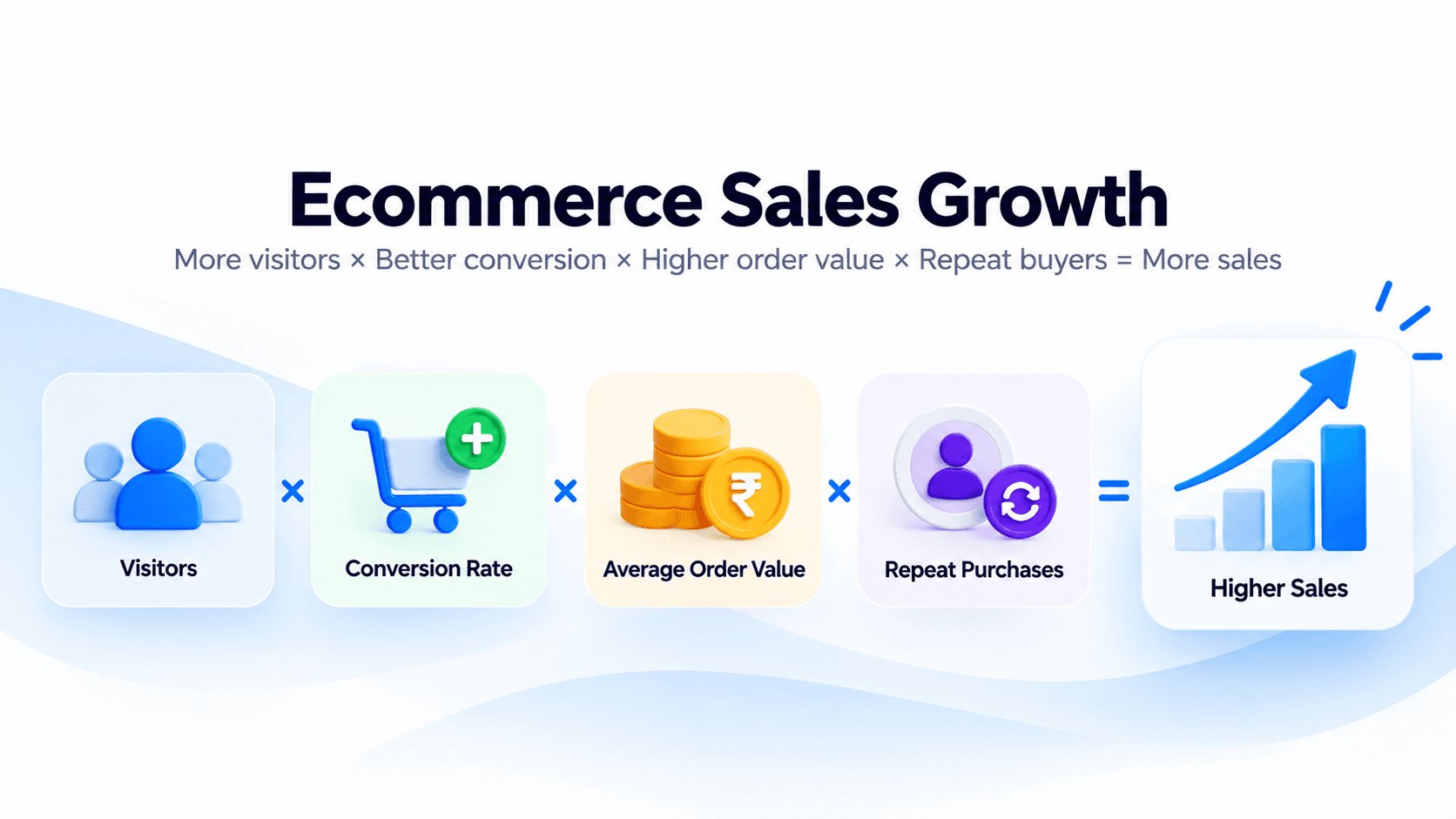
There are four major growth levers:
- Website traffic: How many relevant shoppers visit your store?
- Conversion rate: How many visitors complete a purchase?
- Average order value: How much does each customer spend per order?
- Repeat purchases: How often do existing customers buy again?
A simplified way to understand the relationship is:
Revenue = Website visitors × Conversion rate × Average order value
This formula describes revenue from orders generated during a given period. Repeat purchases contribute by creating additional orders from existing customers.
Consider an illustrative example.
A Shopify store receives 10,000 visitors per month, converts 2% of them, and generates an average order value of ₹2,000.
- Monthly visitors: 10,000
- Conversion rate: 2%
- Orders: 200
- Average order value: ₹2,000
- Monthly revenue: ₹4,00,000
Now imagine the brand improves its conversion rate from 2% to 2.5%, while keeping traffic and average order value unchanged.
It would generate 250 orders and ₹5,00,000 in monthly revenue.
That is ₹1,00,000 more in monthly revenue from the same traffic, assuming the other factors remain constant.
The example illustrates why brands should not focus exclusively on increasing traffic. Improving conversion can also create meaningful growth.
The actual results will depend on the brand's audience, product, margins, marketing costs and customer behaviour.
The first step is to identify which growth lever is currently limiting your business.
2. Attract the Right Website Traffic
More traffic does not automatically mean more sales.
A brand can spend heavily on advertisements and still struggle to generate purchases if the visitors are not interested in its products or are not ready to buy.
The objective should be to attract qualified traffic: people whose needs, preferences and budgets match the products being offered.
Invest in search engine optimization
Search engine optimization (SEO) helps potential customers discover your products and content through organic search.
A brand selling skincare products, for example, could create useful content around choosing products for different skin concerns, understanding ingredients, or comparing product types.
This allows the brand to reach people who are actively researching a purchase.
For SEO to work effectively, brands should create useful pages that match the searcher's intent, optimize product and category pages, improve internal linking, and publish content that answers genuine customer questions.
SEO is a long-term investment, not an immediate guarantee of sales.
Make paid advertising more relevant
Paid advertising can bring visitors quickly, but the quality of those visitors matters.
Brands should evaluate whether their advertisements reach the right audience, communicate a relevant product benefit, and lead to a landing page that matches the advertisement's promise.
If an advertisement promotes a specific product, sending shoppers to a generic homepage may introduce unnecessary steps.
A relevant product or category page can provide a more direct path to purchase.
Align the advertisement with the product page
The message should remain consistent across the entire journey.
If an advertisement promises a particular feature, price or benefit, shoppers should be able to find that information easily after clicking through.
A mismatch between advertising and the landing page can create confusion and reduce purchase confidence.
What brands should measure
Qualified traffic, cost per visitor, product-page engagement, conversion rate by channel, and revenue generated by each campaign.
The goal is not simply to attract more visitors. It is to attract visitors who have a genuine reason to buy.
3. Improve Your Product Pages to Convert More Visitors
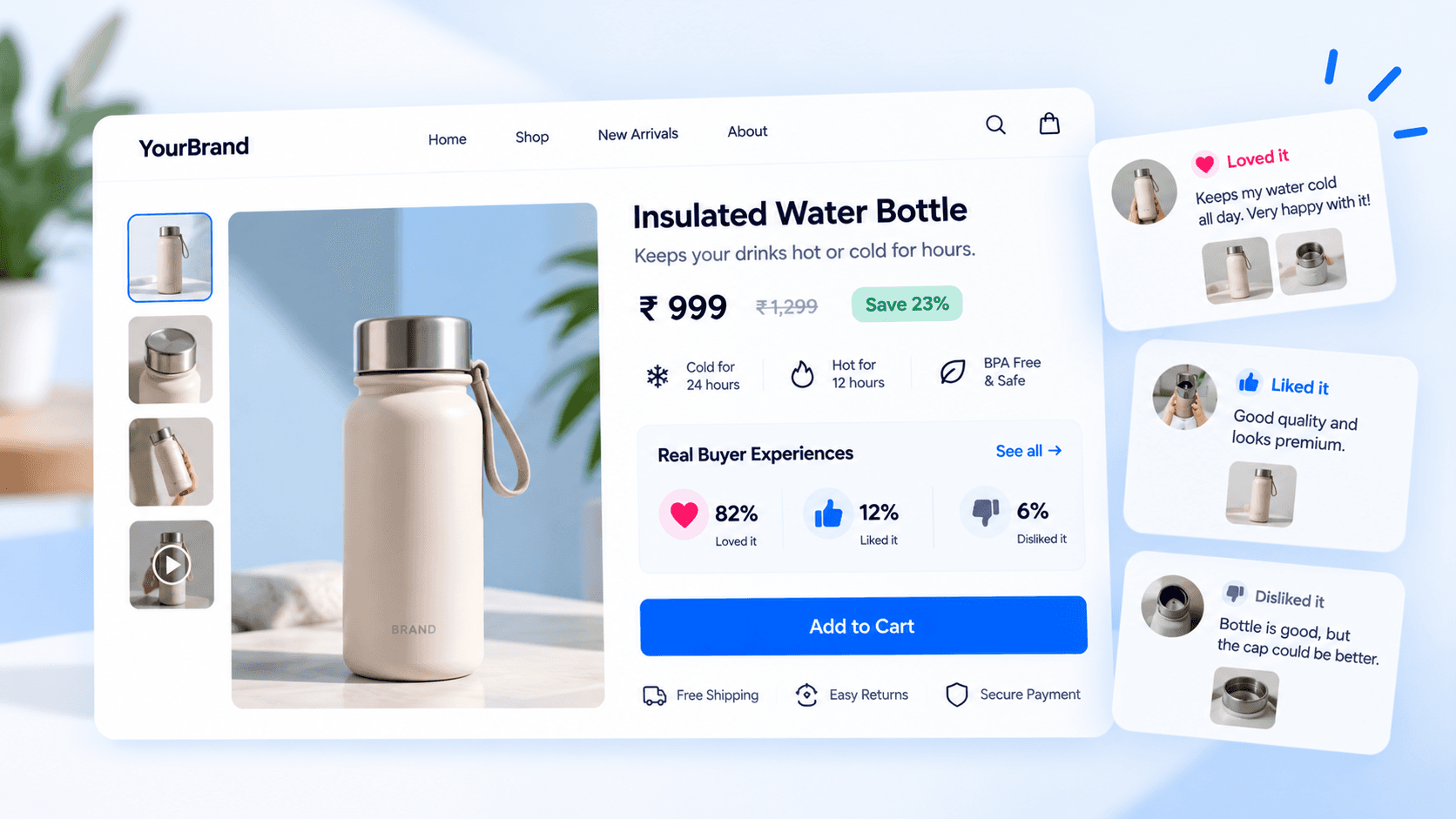
A product page is one of the most important decision-making points in an ecommerce journey.
Shoppers use it to understand what a product does, whether it meets their needs, how much it costs, and whether they can trust the brand selling it.
If essential information is missing, visitors may leave without purchasing—even when the product itself is a good fit.
Write product descriptions that answer real questions
Product descriptions should explain more than features.
They should help customers understand the practical value of the product.
For example, instead of simply stating that a bag is made from water-resistant material, explain what that means for everyday use and what level of protection customers can reasonably expect.
Include dimensions, materials, compatibility, usage instructions, care information and other details relevant to the buying decision.
Avoid vague claims that cannot be substantiated.
Use clear product images and demonstrations
Shoppers cannot physically inspect products online. Images and videos help bridge that gap.
Use multiple product angles, close-up images, demonstrations and contextual visuals where relevant.
For products where appearance, fit, texture or scale matters, visual information can help customers form more realistic expectations.
Make pricing and policies easy to understand
Unexpected costs can create hesitation.
Display pricing clearly and communicate delivery charges, estimated delivery timelines, return policies, warranty information and payment options where relevant.
Do not force shoppers to navigate multiple pages to discover information that could affect their decision.
Design for mobile shopping
Many ecommerce customers browse and purchase on mobile devices.
Product information should be easy to scan, buttons should be accessible, images should load efficiently, and the checkout process should work smoothly on smaller screens.
A product page that looks attractive on desktop but is difficult to use on mobile can create unnecessary friction.
What brands should measure
Product-page conversion rate, add-to-cart rate, engagement with product information, mobile conversion, and exits from key pages.
Improving the product page is not about adding more content indiscriminately. It is about giving shoppers the information they need, in the right order, to make a decision.
4. Build Trust Before Asking Customers to Buy
Online shoppers often face a basic challenge: they must decide whether a product and the brand behind it are trustworthy without experiencing the product beforehand.
They may wonder whether the product will look like the pictures, whether its quality will meet expectations, whether delivery will be reliable, and whether the brand will help if something goes wrong.
These concerns can influence purchase decisions, especially for unfamiliar brands or higher-consideration products.
Make trust visible
Trust should not depend entirely on a brand's own claims about its quality.
Shoppers need useful evidence.
Depending on the product and business, this may include:
- Detailed product information and demonstrations.
- Authentic customer reviews and relevant buyer experiences.
- Clear shipping, return and refund policies.
- Accessible customer support.
- Transparent pricing and product limitations.
- Realistic delivery promises and clear communication.
The aim is to reduce uncertainty without exaggerating what the brand can deliver.
Why customer reviews matter
Customer reviews can help shoppers understand how a product performs in real-world situations.
A product description explains what the brand promises. Customer experiences can add context about what buyers actually received, liked, disliked or found useful.
Research from Northwestern University's Medill Spiegel Research Center found that the presence of reviews can influence purchase likelihood. Its research also found that the effect varies according to factors such as product price, review volume, review content and ratings.
In the study, purchase likelihood for a product displaying five reviews was reported as 270% greater than for a product displaying no reviews. This is a finding from the study's particular dataset and methodology, not a universal prediction for every ecommerce store. Source: Medill Spiegel Research Center.
The important lesson is that relevant customer evidence can help shoppers make better-informed decisions.
Authenticity matters more than looking perfect
Brands sometimes assume that every visible review needs to be overwhelmingly positive.
But shoppers also want realistic information. A mixture of honest experiences, specific product details and evidence that a brand responds constructively to problems can offer a more complete picture.
Brands should never manufacture reviews, suppress legitimate criticism simply to maintain an appearance of perfection, or promise outcomes they cannot substantiate.
What brands should measure
Product-page conversion, interactions with review content, buyer questions, and conversion differences between comparable pages or visitor groups.
Trust is not a decorative element added to a product page. It is part of the decision-making process.
5. Reduce Cart Abandonment and Checkout Friction
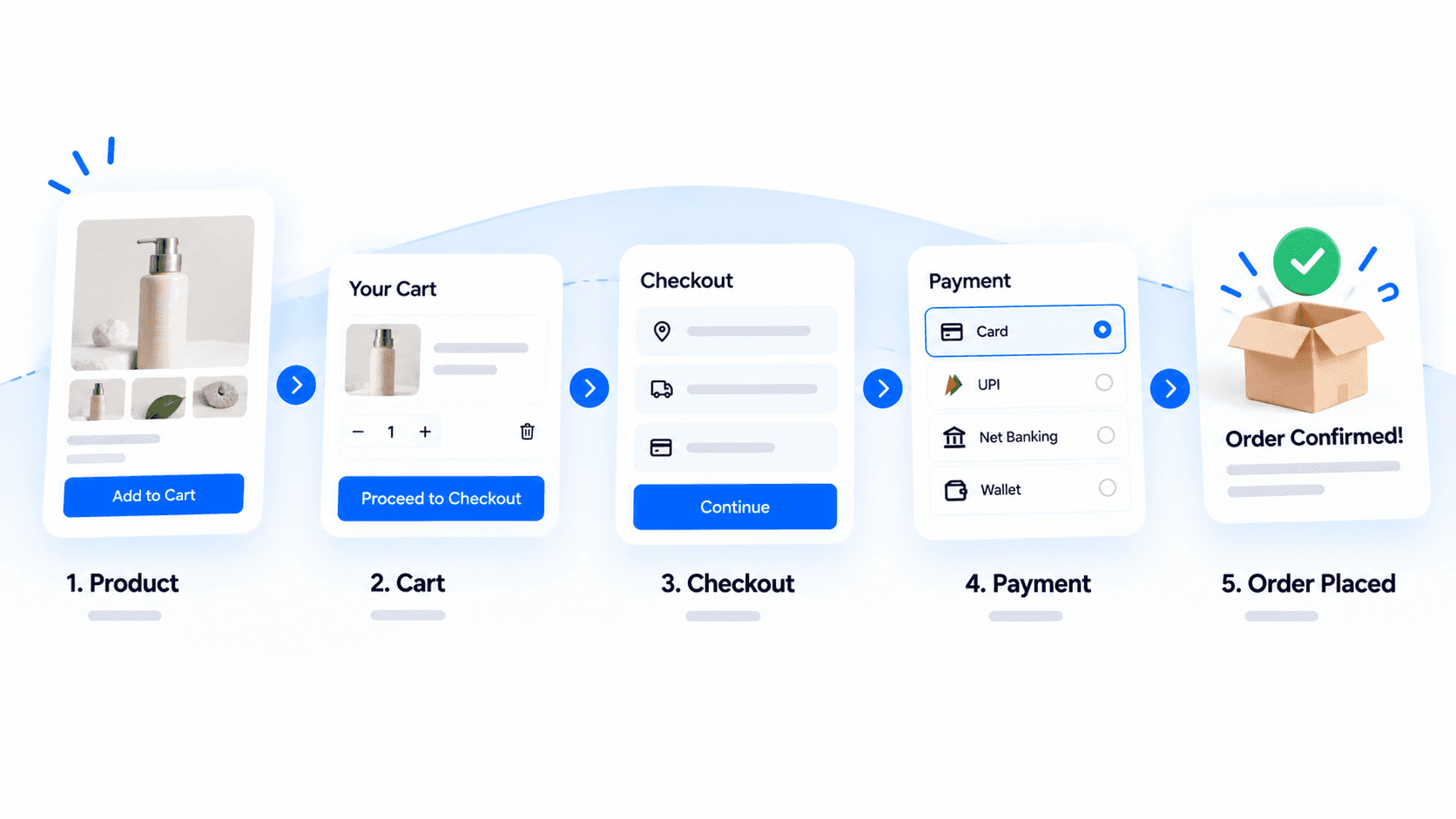
Getting a shopper to add a product to their cart is progress, but it does not guarantee a completed purchase.
Customers may abandon their carts because they are browsing, comparing prices, reconsidering the purchase, or encountering unexpected costs and checkout difficulties.
Baymard Institute's research has reported an average documented ecommerce cart abandonment rate of approximately 70%. This is a broad benchmark, not a target or forecast for every store. Source: Baymard Institute.
Brands should investigate their own abandonment data rather than assume every abandoned cart has the same cause.
Make the checkout process straightforward
Review the complete journey from cart to order confirmation.
Ask whether customers can understand the final price, find available payment methods, enter delivery information easily and complete the purchase without unnecessary obstacles.
Common areas to investigate include:
- Unexpected shipping charges or additional costs.
- Unclear delivery timelines.
- Unnecessary account creation.
- Confusing forms or validation errors.
- Limited payment options.
- Poor mobile checkout usability.
- Unclear return and refund policies.
Not every problem applies to every store. Use analytics, customer questions and usability testing to identify the barriers that matter most.
Use cart recovery thoughtfully
For eligible customers, reminders can help bring shoppers back to an unfinished purchase.
However, recovery messages should be relevant, timely and respectful. A discount is not always the answer; sometimes the customer needs more information, reassurance about delivery, or help with a checkout problem.
What brands should measure
Cart-to-checkout progression, checkout completion, abandonment by step, payment failure rates, and recovered orders.
Reducing friction can help a brand convert more of the demand it has already generated.
6. Increase Average Order Value Without Undermining Trust
Increasing sales does not always require acquiring more customers. Brands can also increase revenue per order by helping customers discover products that genuinely complement their purchases.
Offer relevant product bundles
A skincare brand might bundle products designed to work together. A fashion brand might suggest a complementary accessory.
The bundle should offer a clear customer benefit rather than simply encouraging unnecessary spending.
Use cross-selling and upselling carefully
Recommend related products when they are relevant to the customer's needs.
Upselling may be appropriate when a more expensive option offers a meaningful improvement. Cross-selling may help when another product complements the original purchase.
Avoid aggressive pop-ups, misleading discounts or recommendations that distract from the purchase.
Make offers easy to understand
If you offer bundles, quantity discounts or free-shipping thresholds, communicate the terms clearly.
Customers should be able to understand what they receive and what they need to spend to qualify.
What brands should measure
Average order value, bundle purchase rate, revenue per visitor, contribution margin and return rates.
Higher order value is useful only when it contributes to profitable growth and a good customer experience.
7. Turn First-Time Customers Into Repeat Buyers
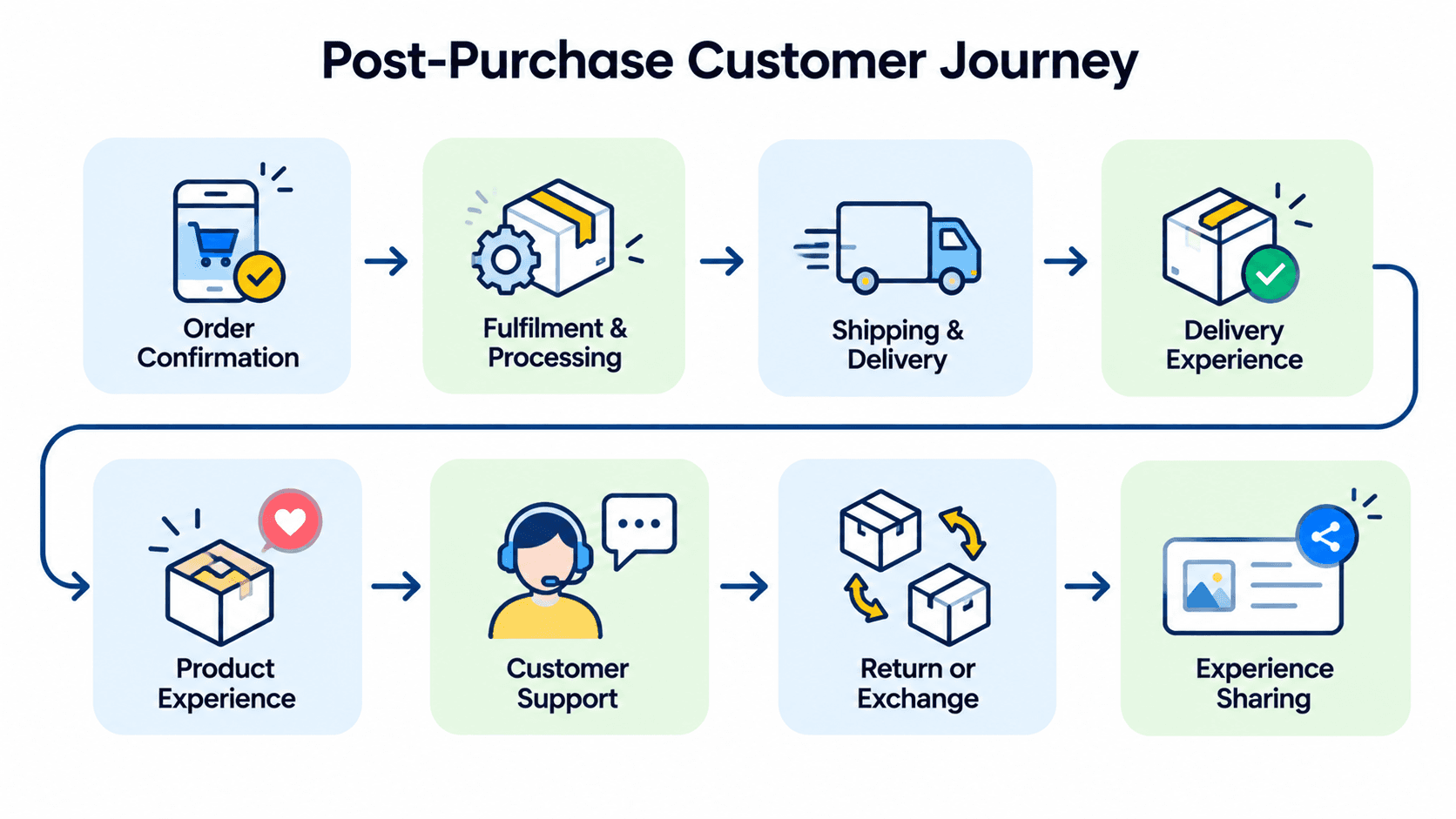
A completed order is not the end of the customer journey.
After purchasing, customers form an opinion about the product, delivery, packaging, communication and support. That experience influences whether they buy again, recommend the brand or choose a competitor next time.
Keep customers informed after purchase
Send relevant order confirmations, delivery updates and product-use information.
Customers should not have to search through a website to understand the status of an order or find help when something goes wrong.
Make support accessible
When customers encounter a problem, give them a clear way to contact the brand.
A damaged item, missing delivery or product that does not meet expectations should lead to a helpful process rather than a frustrating search for contact information.
Encourage the next relevant purchase
Retention campaigns can include replenishment reminders, useful product recommendations, loyalty programmes and relevant offers.
The timing should reflect the customer's actual needs. A replenishment reminder makes sense for a consumable product but may be inappropriate for an item that customers purchase only occasionally.
Learn from the experience after delivery
Customer experiences can reveal recurring problems that sales data alone may not explain.
If customers repeatedly mention sizing confusion, for example, the brand may need better size guidance. If customers report difficulty using a product, clearer instructions may help. If delivery concerns recur, the brand may need to investigate its fulfilment process.
These insights can support better products, clearer communication and more relevant future purchases.
What brands should measure
Repeat purchase rate, time between purchases, customer retention, customer lifetime value, support resolution and product-related return reasons.
Retention is not simply a marketing activity. It is closely connected to what happens after the customer pays.
8. Use Customer Reviews to Discover What Is Holding Sales Back
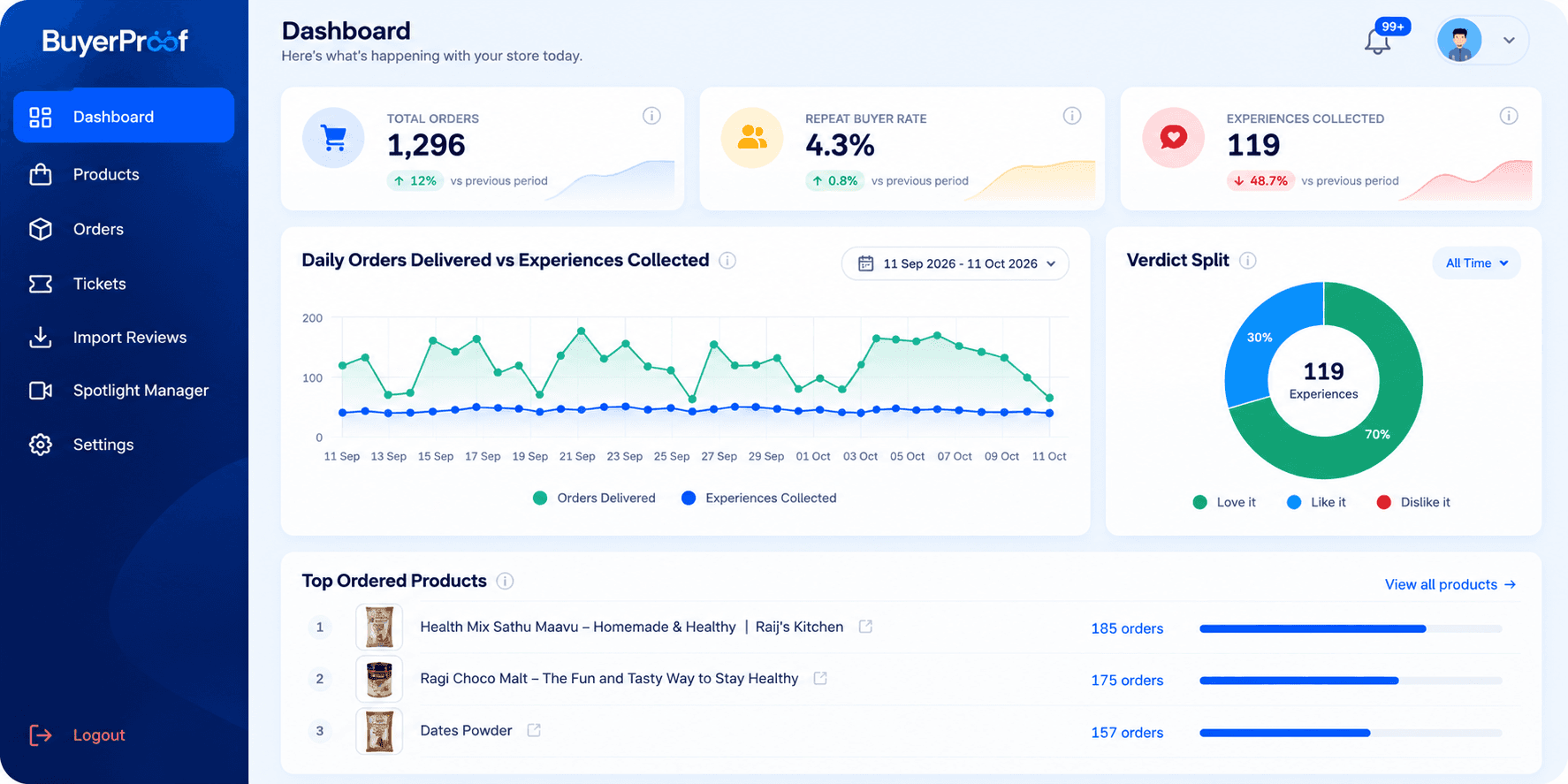
Customer reviews are often treated as content to display on a product page. But they can also help brands understand why shoppers hesitate and what existing customers experience.
A review might reveal that a product fits smaller than expected. Another might explain that the packaging is difficult to open. A third might praise a feature that the brand has not clearly communicated in its advertising.
These observations can inform product descriptions, campaigns, product development and support.
Identify recurring questions and concerns
Look beyond the overall rating.
Group experiences by meaningful themes such as product quality, fit, durability, delivery, usability, packaging and customer service.
This can help brands identify issues that deserve attention and product benefits that deserve clearer communication.
Do not ignore customers who remain silent
A major challenge in review collection is that many customers never submit a review, even when they have purchased and used the product.
Silence does not necessarily indicate dissatisfaction. Customers may be busy, forget the request, find the process inconvenient or simply see no reason to respond.
Others may need support more urgently than they want to write a public review.
Brands should make sharing an experience easy and give customers an appropriate route to seek help. They should not assume that every non-response has the same explanation.
Measure review collection properly
A useful starting point is to define a consistent collection rate:
Review collection rate = Orders that generate a review ÷ Eligible orders sent a review request × 100
For example, if 1,000 eligible orders receive review requests and 40 generate a review, the collection rate is 4%.
This is an illustrative calculation, not an industry benchmark. Brands should define the measurement window, eligibility criteria and what counts as a review consistently when comparing tools or campaigns.
Track the rate by product, request timing and channel where possible. This helps reveal where the collection journey could improve.
What brands should measure
Collection rate, time to submission, completion by channel, content quality, recurring product concerns and the proportion of experiences that lead to support interactions.
The goal is not to pressure every customer to respond. It is to make it easier for willing customers to share useful experiences and to learn from what they communicate.
9. Do Customer Reviews Really Increase Conversion?
The short answer is that customer reviews can influence conversion, but the impact depends on the context.
Reviews can reduce uncertainty, help customers compare products and provide evidence beyond a brand's own marketing claims.
However, displaying reviews alone does not guarantee a higher conversion rate.
A product may have many reviews but still have unclear pricing, poor images, a complicated checkout process or a product that does not meet the needs of its intended audience.
Likewise, a small collection of detailed, relevant experiences may answer a shopper's questions more effectively than a larger collection of generic comments.
Focus on usefulness, not just quantity
Brands should consider whether reviews answer practical questions.
For example:
- Does the product perform as described?
- What should a customer know before buying?
- How does the product work in everyday use?
- What limitations should shoppers understand?
- How does the brand respond when something goes wrong?
Useful information can help shoppers decide whether the product is right for them.
Test the impact on your own store
If a brand wants to understand whether a review widget improves conversion, it should measure the outcome rather than assume success.
Where feasible, compare similar visitor groups or run a controlled experiment. Keep other important variables consistent, such as price, promotions, traffic source and page layout.
Measure conversion alongside add-to-cart rate, customer questions and returns. This helps distinguish a genuine improvement from a change in traffic or purchasing conditions.
Reviews are one part of conversion optimization—not a substitute for it.
The strongest strategy combines relevant traffic, useful product information, a clear buying journey and trustworthy customer evidence.
10. Choose Tools Based on the Business Problem You Need to Solve
Once a brand identifies its sales challenges, the next step is to decide which tools can address them.
There is no single platform that automatically solves every ecommerce growth problem.
A brand struggling to attract relevant visitors may need to improve its SEO and advertising. A store with strong traffic but low checkout completion may need usability improvements. A brand with very few customer reviews may need a better collection process.
A business dealing with recurring product concerns may need better customer insights and support workflows.
What to evaluate when choosing a review platform
When comparing ecommerce review platforms, consider:
- Review request automation and collection rate measurement.
- The ease of submitting text, photo and video experiences.
- Product-page display and integration with the existing store.
- The relevance and usefulness of collected customer content.
- Reporting and insight into recurring product concerns.
- The ability to support customers when they have an issue.
- How the platform fits the brand's wider post-purchase journey.
Some brands may need a tool focused mainly on review collection and display. Others may need a broader approach that connects customer experiences with support and issue resolution.
The decision should follow the business requirement—not the number of features on a pricing page.
Think beyond adding another tool
If a brand's only goal is to increase the number of displayed reviews, a traditional review platform may address that requirement.
But if the wider challenge is understanding buyer experiences, helping customers get support and making those experiences useful for future shoppers, the brand should evaluate whether its existing tools connect those activities effectively.
That is a different business question, and it deserves a broader evaluation.
11. How BuyerProof Helps Brands Look Beyond Review Collection
BuyerProof is designed for Shopify brands that want to connect real buyer experiences with post-purchase support and buyer confidence.
Traditional review collection focuses primarily on gathering and displaying customer reviews. BuyerProof takes a broader view of the post-purchase journey by connecting buyer experiences with the opportunity for brands to respond to concerns and address issues.
This matters because a customer interaction can contain more value than a rating alone.
A positive experience may help a future shopper understand what to expect. A negative experience may reveal a product or service issue that deserves attention. A support interaction may give the brand an opportunity to resolve the problem and demonstrate accountability.
These are different parts of the same customer journey.
Make buyer experiences useful to future shoppers
Customers considering a product often want to know more than whether previous buyers liked it. They may want to understand how the product performs, what to expect after delivery and what happens if something goes wrong.
Real buyer experiences can provide that context.
Connect customer experience with support
When a buyer has a concern, an accessible support journey gives the brand an opportunity to respond.
Resolving issues can improve the individual customer's experience and help the brand identify recurring problems. A resolution should never be assumed or promised automatically; it depends on the brand's actual response and outcome.
Treat experience data as an opportunity to improve
When brands pay attention to what buyers share, they can identify recurring product questions, understand common concerns and find opportunities to improve communication.
The objective is not simply to collect more content. It is to create a more useful connection between the people who buy a product, the brand that sells it and the next shopper making a decision.
BuyerProof helps brands connect buyer experiences, post-purchase support and transparent outcomes—so they can look beyond review counts and focus on building buyer confidence.
For brands evaluating their next step, the question is worth asking: are your tools helping you collect reviews alone, or are they helping you understand and improve the complete buyer experience?
Conclusion: Sustainable Ecommerce Growth Starts With Understanding the Buyer
Increasing ecommerce sales requires more than one tactic.
Brands need to attract relevant visitors, communicate product value clearly, make purchasing straightforward, build trust, improve average order value and give existing customers reasons to return.
Customer reviews can support several of these goals by helping shoppers make informed decisions and giving brands insight into real product experiences. But reviews are not the entire customer experience, and collecting more of them does not automatically guarantee more sales.
The opportunity is to understand the complete journey.
Why do shoppers hesitate? What information do they need before buying? What makes them abandon a purchase? What happens after delivery? Which customer concerns keep appearing? And how effectively does the brand respond?
Answering these questions helps brands identify the barriers that matter most and invest in improvements that address real problems.
For D2C and Shopify brands, the next step is not necessarily to add another tool. It is to identify the growth problem, understand the buyer behind it and choose solutions that support the outcome the business needs.
Don't focus only on getting more visitors or collecting more reviews. Focus on helping the right buyers make confident decisions—and giving them a reason to come back.
Explore BuyerProof to learn how buyer experiences and post-purchase support can become part of a stronger customer experience strategy.
37 Reactions
About the Author
Product Designer & Strategist